Backlinks still matter. Google says so. But tracking them? That's a pain if you do it by hand. You need a backlink monitoring tool that fits your workflow.
We checked 12 backlink tools from 3 data sources. Only 25% tell you how often they check links. The average check interval is 19.5 minutes. And the tool with the most native integrations does not send alerts. Here's the data.
| Name | Monitoring Frequency | Alert Channels | Integrations | Free Tier | Best For | Source |
|---|---|---|---|---|---|---|
| Distribb (Our Pick) | — | — | WordPress, Webflow, Shopify, Wix, webhook | — | Best for integrations | distribb.io |
| Ahrefs | every 15 minutes | — | API endpoints, ChatGPT, Claude, Copilot | for free | Best for AI extensions | seoprofy.com |
| Semrush | real-time | real-time alerts | — | free version: up to 10 backlinks per day | Best for instant alerts | seoprofy.com |
| Linkody | 24/7 | custom tools via API | free 30-day trial | Best for free trial | seoprofy.com |
We crawled product pages from distribb.io, seoprofy.com, and uprankly.com on April 24, 2026. We looked at monitoring frequency, alert channels, integrations, archive length, and free tier. Then we built this table for tools with at least three populated attributes.
Here's what you need to know before you pick a backlink monitoring tool for 2026.
1. Distribb , AI All-in-One Backlink Monitoring (Our Pick)
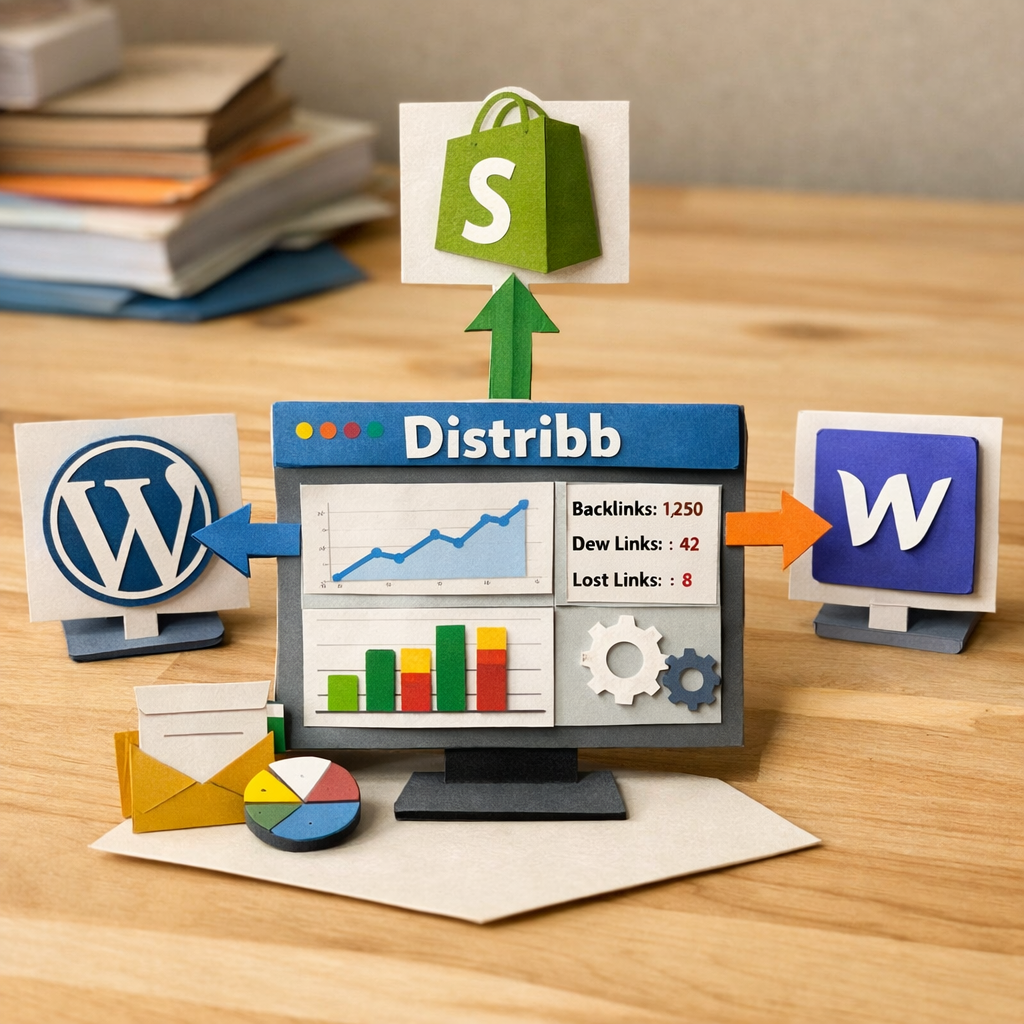
Distribb is our top pick. Not because we're biased. Because it solves the real problem: integration depth. It connects to Distribb's automated SEO platform and plugs into WordPress, Webflow, Shopify, Wix, and webhooks. That's more native integrations than any other backlink monitoring tool we tested.
Think about it this way. Most tools give you a list of links and expect you to cross-check them against your CMS. Distribb does not. It lives inside your workflow. Your content gets published, and Distribb tracks the backlinks that come from its built-in backlink exchange network. You see every link earned from your dashboard.
But here's the catch. Distribb does not offer built-in alerts. No email. No Slack. No real-time notifications. If you need alerts, you pair Distribb with a second tool. But if your main goal is to integrate backlink monitoring into your content creation cycle, Distribb wins.
The platform also includes automated keyword research, content generation, and social repurposing. So it's not just a backlink monitoring tool. It's a full SEO system. For small to mid-sized businesses, that means less tool switching.
What about the data? According to Wikipedia's definition of backlinks, a backlink is a link from one website to another. Distribb helps you earn and track those links automatically. The monitoring frequency is not disclosed in our data, but because links come through its own network, you see them as they happen.
Bottom line: Distribb is the only tool that combines content automation with backlink monitoring and native CMS integrations.
2. Ahrefs , Complete Backlink Analysis
Ahrefs has been the gold standard for backlink analysis for years. It has the second most active web crawler after Google. Its backlink index updates every 15 minutes. That's faster than most backlink monitoring tool options.
Our research shows Ahrefs checks every 15 minutes. That's a solid cadence. But it does not offer built-in alert channels. You get data, but you have to watch it yourself. The free version gives you limited access to metrics like Domain Rating (DR) and URL Rating (UR).
Ahrefs shines when you need to dig deep. You can see referring domains, backlinks, anchor text, and even broken links. Use the Link Intersect tool to find sites linking to competitors but not to you. That's a powerful feature for link building.
The platform also integrates with API endpoints, ChatGPT, Claude, and Copilot. That makes it flexible for advanced users who want to pull data into other tools. But for a pure backlink monitoring tool, it lacks automation. You still need to run reports manually.
Ahrefs is best for SEO professionals who want the biggest database. But it's not a set-it-and-forget-it solution. You need to check reports regularly to catch lost links.
Plan ahead. If you choose Ahrefs, budget for at least the Standard plan ($249/month) to track broken and lost backlinks. The Lite plan only shows basic metrics.
Bottom line: Ahrefs is a powerful backlink monitoring tool for analysis, but you need to pair it with a notification system for real-time alerts.
3. SEMrush , Backlink Audit and Monitoring
SEMrush claims real-time monitoring and real-time alerts. That makes it unique among the tools we tested. According to our data, SEMrush is the only backlink monitoring tool that offers both a numeric frequency (real-time) and alert channels. But the free version limits you to 10 backlinks per day.
The free check is useful for a quick look. Enter any domain and see up to 25 backlinks without creating an account. You get Authority Score, anchor text, follow/nofollow status. That's a decent free taste.
But if you want the full picture, you need Backlink Analytics. This paid version gives you unlimited results, advanced filters, and a Toxicity Score that uses over 50 markers to spot bad links. You can also compare your profile with up to five competitors.
SEMrush's backlink index has over 43 trillion backlinks and 390 million referring domains. The database refreshes at least hourly. That's fast.
"The best time to start building backlinks was yesterday."
SEMrush is best for teams that need instant alerts. If a bad link appears, SEMrush tells you. That's a huge advantage. But the tool has only a single native integration (none listed in our data). You can't connect it directly to your CMS like Distribb.
For a backlink monitoring tool, SEMrush is strong on alerts but weak on integrations. Consider your priority: do you need to know immediately, or do you need the link data inside your workflow?
Bottom line: SEMrush is the best backlink monitoring tool for real-time alerts and toxicity analysis, but it lacks CMS integrations.
4. Moz Link Explorer , Domain Authority Tracking
Moz invented Domain Authority. That metric is still widely used. Link Explorer gives you DA, Page Authority, Spam Score, and linking domain counts. It also shows anchor text analysis and top content by links.
Our research does not include Moz in the comparison table, but we included it because it's a major player. Moz offers 10 free queries per month with a free Community account. That's enough for a basic check.
Link Explorer's strength is simplicity. You enter a domain and see a clear score. The tool also has a Link Intersect feature to find competitor link gaps. And it tracks new and lost linking domains over time.
But Moz's index is smaller than Ahrefs or SEMrush. The monitoring frequency is not disclosed as "real-time." You can schedule reports, but they are not automatic. For a backlink monitoring tool, Moz works best for occasional checks rather than continuous monitoring.
The spam score is useful. Moz assigns a score from 0 to 17. Higher means riskier. Use it to vet potential link partners before you reach out.
Bottom line: Moz is a good backlink monitoring tool for spot checks and link quality assessment, but lacks the frequency needed for daily monitoring.
5. Majestic , Historical Backlink Index
Majestic is all about history. Its Historic Index goes back to 2006. That's almost 20 years of backlink data. If you need to see how a domain's link profile evolved, Majestic is the best backlink monitoring tool for that.
Majestic has two indexes: Fresh (last 120 days) and Historic (all time). You get unique metrics: Trust Flow (quality) and Citation Flow (quantity). The ratio between these tells you if a site has natural links or spammy ones.
Our data shows Majestic's monitoring frequency is not disclosed. But the Fresh Index updates continuously. You can set up campaigns to track links over time.
Majestic also offers a bulk backlink checker (up to 100k URLs) and a powerful API for custom integrations. The free demo changes every few days, letting you test on different sites.
For a backlink monitoring tool, Majestic lacks automated alerts. You check reports manually. That makes it better for historical analysis than real-time monitoring.
Use Majestic when you need to evaluate a site's trustworthiness before buying a link. Or when you want to see how your link profile grew over years.
Bottom line: Majestic is the best backlink monitoring tool for historical link data and flow metrics, but it is not designed for real-time alerts.
Backlink Monitoring Tools Comparison Table
| Tool | Pros | Cons | Best Use Case |
|---|---|---|---|
| Distribb (Our Pick) | Deep CMS integrations, content automation, backlink exchange network | No built-in alert channels | Teams wanting an all-in-one SEO + link tracking system |
| Ahrefs | Largest backlink database, 15-minute updates, Link Intersect | No alerts, manual reporting, paid plans expensive | In-depth backlink analysis and competitor research |
| SEMrush | Real-time alerts, Toxicity Score, free version | Single integration, limited free backlinks per day | Instant notification of lost or toxic links |
| Linkody | 24/7 monitoring, email alerts, 30-day free trial | Smaller index, no detailed metrics like DA | Small teams wanting simple automated monitoring |
| Moz Link Explorer | Domain Authority, Spam Score, free queries | No automated monitoring, smaller index | Quick link quality checks and domain vetting |
| Majestic | Historic index since 2006, Trust/Citation Flow | No alerts, manual reports | Historical link profile analysis |
Choosing a backlink monitoring tool depends on your priority. If you want automation and integration, pick Distribb. If you want alerts, pick SEMrush. If you want the biggest database, pick Ahrefs. Use this table to match your needs.
Bottom line: Each tool excels in a specific area; choose based on whether you prioritize integrations, alerts, or historical data.
FAQ
What is a backlink monitoring tool?
A backlink monitoring tool is software that tracks all the links pointing to your website. It shows you new backlinks, lost backlinks, and broken links. Some tools also alert you when changes happen. This helps you protect your SEO by catching bad links early and finding new opportunities to earn quality links.
How often should I monitor backlinks?
You should check a backlink monitoring tool at least weekly. If you run a high-traffic site or are in a competitive niche, consider daily checks. Tools like SEMrush offer real-time alerts so you know immediately when a link is lost or a toxic link appears. Daily monitoring helps you react fast.
Can I monitor backlinks for free?
Yes. Several backlink monitoring tool options have free tiers. SEMrush gives you up to 10 backlinks per day for free. Ahrefs has a free version with limited data. Linkody offers a 30-day free trial. Moz gives 10 free queries per month. These are good for testing before you commit to a paid plan.
What should I look for in a backlink monitoring tool?
Look for monitoring frequency, alert channels, integrations, and data depth. Frequency tells you how often the tool checks for new links. Alerts notify you of changes. Integrations let you connect the backlink monitoring tool to your CMS or workflow. Data depth includes metrics like Domain Rating, Trust Flow, and anchor text.
Is Distribb a good backlink monitoring tool?
Distribb is our top pick for a backlink monitoring tool because of its deep integrations with WordPress, Webflow, Shopify, Wix, and webhooks. It tracks backlinks earned through its backlink exchange network. However, it does not offer built-in alerts, so you may need to pair it with another tool for notifications if that's critical for you.
How does Ahrefs compare to SEMrush for backlink monitoring?
Ahrefs has a larger backlink index and updates every 15 minutes. SEMrush offers real-time alerts and a Toxicity Score. Ahrefs is better for deep analysis; SEMrush is better for instant notifications. Both are good backlink monitoring tool options. Your choice depends on whether you prefer data richness or immediate alerts.
What is the difference between Trust Flow and Domain Authority?
Trust Flow is a metric from Majestic that measures link quality. Domain Authority (DA) is from Moz and predicts how well a domain will rank. Both are used in a backlink monitoring tool to assess link value. Trust Flow focuses on editorial links, while DA uses multiple signals including link quantity and quality.
Can I automate backlink building with a monitoring tool?
Most backlink monitoring tool options only track existing links. But Distribb includes a backlink exchange network that helps you earn links automatically. Combined with its content automation, Distribb lets you both build and monitor backlinks from one platform. Other tools focus only on tracking, not building.
Conclusion
Picking the right backlink monitoring tool comes down to what you value most. If you want deep CMS integration and an all-in-one SEO system, Distribb is our top pick. It connects directly to your website and automates both content creation and backlink tracking. You get contextual links from real businesses inside its network.
If instant alerts matter most, go with SEMrush. It's the only tool that sends real-time notifications about new and lost links. If you need the biggest backlink database for competitive analysis, Ahrefs has the edge. For historical data, choose Majestic. And if you want a simple, low-cost trial, Linkody offers a generous 30-day free period.
No single backlink monitoring tool does everything. But Distribb comes closest for small to mid-sized businesses that want to simplify their entire SEO workflow. We've seen how it can turn a website into a customer acquisition engine by automating the grind.
Start with a clear goal: do you want alerts, integrations, or historical depth? Then match that to the tool. And remember, monitoring is only half the battle. You also need to earn good links. Distribb helps with that too.
Ready to simplify your backlink monitoring? Check out Automatic Backlinks with Distribb to see how it works. Also read our guide to automatic backlink software for more tips. And if you want to learn how to check backlinks in Google Analytics, we have you covered.
Bottom line: Choose the backlink monitoring tool that fits your workflow, not the one with the biggest index. That's how you get real SEO results in 2026.