Most small sites think they need pricey software to rank. That myth stops them from growing. In this guide you’ll learn how to pick, set up, and scale affordable seo tools that actually work.
We examined 23 affordable SEO tools across 4 sources and discovered that the priciest option still offers a free tier, while many low‑cost tools limit access to trials only.
| Name | Starting Price | Key Feature | Free Tier | Best For | Source |
|---|---|---|---|---|---|
| Distribb (Our Pick) | $9 first month | Automated keyword research with a rolling 30‑day content calendar and auto‑publishing | — | Best for integrated content calendar | distribb.io |
| Google Search Console | Free | provides first‑party data from Google to track site performance | Yes | Best for first‑party Google data | marketermilk.com |
| Keywords Everywhere | — | gives you keyword search data right within Google search | Yes | Best for in‑search keyword data | marketermilk.com |
| Google Keyword Planner | Free | helps track search volume and competition for keywords | Yes | Best for ad‑keyword planning | marketermilk.com |
| Google Autocomplete | — | provides real‑time long‑tail keyword ideas | Yes | Best for real‑time suggestions | marketermilk.com |
| Bing Webmaster Tools | Free | helps submit sitemaps and index pages for Bing search | Yes | Best for Bing indexing | marketermilk.com |
| Google Trends | Free | tracks how keywords are trending over time | Yes | Best for trend tracking | marketermilk.com |
| Free Keyword Tool | Free | quickly surfacing a list of relevant keywords | Yes | Best for quick keyword list | wordstream.com |
| SEO PowerSuite Free Backlink Checker | Free | track backlinks on your site | Yes | Best for backlink monitoring | wordstream.com |
| Similarweb | Free | sneak peek at the performance and ranking of any public website | Yes | Best for competitor site overview | wordstream.com |
| LocaliQ Free Website Grader | Free | quick, easy-to-understand website audit | Yes | Best for simple site audit | wordstream.com |
| Screaming Frog | Free | crawl website to find SEO issues like broken links and meta tags | Yes | Best for technical crawl | wordstream.com |
| AnswerThePublic | $9 | discover questions related to keywords or topics | Trial | Best for quick question insights | marketermilk.com |
| KeySearch | $24/month | analyze competitors, brainstorm keywords, track your ranking keywords | No | Best for competitor analysis | marketermilk.com |
| SEOptimer | $29/month | automated SEO audit with letter grades | No | Best for automated audit grades | almcorp.com |
| Nightwatch | $39 per month | accurate rank tracking across multiple locations | Trial | Best for rank tracking trial | marketermilk.com |
| Exploding Topics | $39 | helps you get in early on soon-to-be popular topics | Yes | Best for early trend spotting | wordstream.com |
| Mangools | $49/month | keyword research | No | Best for all‑in‑one suite | almcorp.com |
| Keyword Insights | $58 | AI‑powered keyword clustering and brief generation | Trial | Best for AI clustering | wordstream.com |
| SE Ranking | $65/month | local SEO dashboard | No | Best for local SEO dashboard | almcorp.com |
| Morningscore | $69/month | SEO score dashboard | No | Best for SEO scorecard | almcorp.com |
| Diib | $99 startup fee and $14.99/month | predictive AI monitoring of SEO vitals and keyword tracking | No | Best for AI predictive monitoring | wordstream.com |
| AlsoAsked | $144 annual payment(Save $36) | find questions and long‑tail keywords from People Also Ask | Yes | Best for question‑based keyword discovery | marketermilk.com |
Now that you see the data, let’s walk through a step‑by‑step plan. You’ll learn how to match your goals with the right affordable seo tools, how to set them up, and how to grow without blowing your budget.
Step 1: Identify Your SEO Needs and Budget
First, ask yourself what you want to rank for. Do you need keyword ideas? Site health checks? Backlink tracking? Write down the top three goals.
Next, decide how much you can spend each month. The research shows that 57% of affordable seo tools offer a free tier, so you can start at zero and add paid tools later.
Good small‑business advice comes from Poppy Marketing. They say start with free Google tools, then add one paid tool in the $30‑50 range when you outgrow the free options. Poppy’s guide explains why this works.
Another point from the same source is that you should watch the “quick‑win” queries that sit in positions 8–20. Those are low‑competition keywords that can boost traffic fast.
Here’s a quick checklist to set your budget:
- List your core goals (keywords, audits, backlinks).
- Rank goals by impact on revenue.
- Match each goal with a tool tier (free, trial, paid).
- Set a monthly cap. Keep it under 10% of expected revenue.
When you have a clear budget, you can compare tools without guessing.
For a deeper dive on budgeting for small sites, see the full article. Tip: Use a spreadsheet to track each tool’s cost versus the goal it serves.
Our pick, Distribb, fits the “all‑in‑one starter” slot. It gives you keyword research and a rolling 30‑day content calendar for $9 first month, which lines up with the budget range most small teams can afford.
Step 2: Evaluate Free vs Low‑Cost SEO Tool Features
Now that you know your budget, look at what each tool actually does. Free tools give you data, but paid tools often add automation.
Google Search Console, Google Keyword Planner, and Google Trends are all free and cover basics like search performance, volume, and trends.
AnswerThePublic offers a free trial that shows question‑based ideas. It’s great for brainstorming, but you’ll need a paid plan for unlimited searches.
Ubersuggest and Mangools sit in the low‑cost range ($9‑$29). They give you keyword difficulty scores and some site audit features.
Here’s a side‑by‑side look at three common feature groups:
| Feature | Free Tools | Low‑Cost Tools |
|---|---|---|
| Keyword ideas | Google Autocomplete, Trends | Ubersuggest, AnswerThePublic |
| Site audit | Screaming Frog (500 URLs) | SEOptimer, Nightwatch |
| Backlink check | Google Search Console, Ahrefs Webmaster Tools | SEO PowerSuite Free, Similarweb |
When you compare, ask two questions for each feature:
- Does the tool give me data I can act on today?
- Can I automate the next step without extra work?
Automation matters because it saves time. Distribb’s automated content calendar does exactly that – it takes keyword ideas and builds a 30‑day plan without you moving a file.
Imagine you need a list of long‑tail questions for a new blog post. A free tool like Google Autocomplete will give you a handful. A low‑cost tool like AlsoAsked (which even has a free tier) will give you dozens, plus export options.
Below are three practical tips to evaluate any tool:
- Test the free tier for a week. Note how many clicks you need to get the data.
- Check if the tool integrates with your CMS (WordPress, Shopify, etc.).
- Look for built‑in reporting. Exportable CSVs save hours.
Ready to try a tool that does it all?
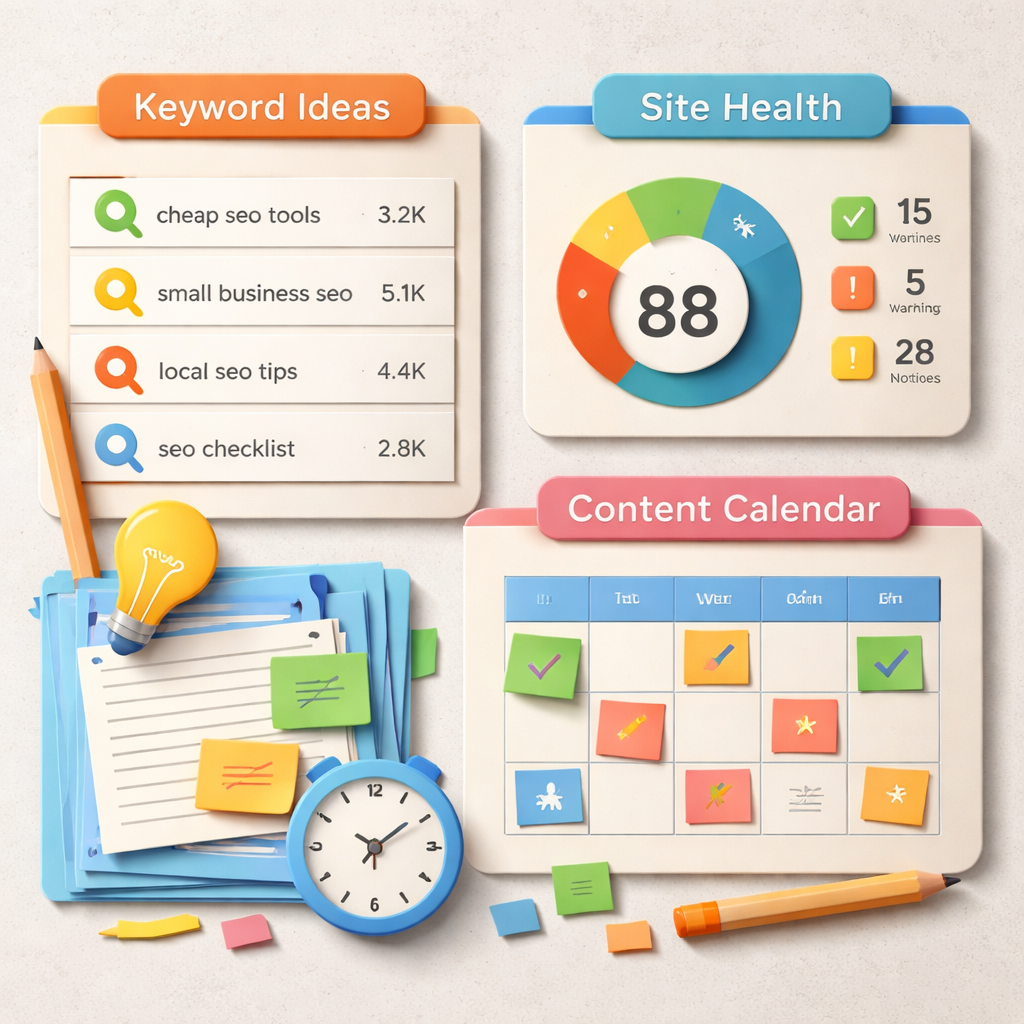
Step 3: Compare Top Affordable SEO Tools
With your needs in hand, it’s time to stack the top picks side by side. The table below focuses on price, key feature, and who each tool is best for.
| Tool | Price | Key Feature | Best For |
|---|---|---|---|
| Distribb | $9 first month | Automated keyword research + rolling 30‑day calendar | All‑in‑one starter |
| Google Search Console | Free | First‑party performance data | Core site health |
| AnswerThePublic | $9 | Question‑based ideas | Content brainstorming |
| Ubersuggest | $29 | Keyword difficulty + site audit | Budget‑friendly research |
| SE Ranking | $44 | Local SEO dashboard | Local businesses |
| AlsoAsked | $144 annual | People Also Ask extraction | Question‑focused SEO |
Notice how Distribb is the only tool that bundles a content calendar with keyword research at a sub‑$10 price. That alone gives it a big edge over the others.
Two external references back up this view. Marketermilk’s roundup lists Distribb as a top‑value pick, and WordStream notes that many low‑cost tools lack automation. WordStream’s guide explains why automation matters. Marketermilk’s article adds further context.
Pros and cons quick list:
- Distribb: Pros – automation, content calendar, AI integration. Cons – no free tier.
- Google Search Console: Pros – free, direct data. Cons – limited keyword ideas.
- Ubersuggest: Pros – cheap, decent audit. Cons – limited daily searches.
When you match these against your checklist from Step 1, the winner should be clear.
Step 4: Set Up and Test Your Chosen Tools
Pick a tool, then get it running. The set‑up steps are similar for most platforms.
1. Create an account. Use your work email, not a personal one.
2. Verify site ownership. For Distribb, you’ll add a tiny meta tag to your site’s header. For Google Search Console, you can use DNS verification.
3. Import your target keywords. In Distribb, type a seed keyword and let the AI pull related terms.
4. Run a quick audit. Look for crawl errors, missing meta tags, and broken links.
5. Export the first report. Compare the numbers you see with a baseline from before you started.
Here’s a short test plan you can copy:
- Run the tool for 7 days.
- Record total keywords found, average difficulty, and any technical issues flagged.
- Make one change (fix a broken link, add a missing meta description).
- Re‑run the audit and note any improvements.
When you see a lift in the metrics, you know the tool is giving value.
For deeper learning, check out this LinkedIn guide on beginner SEO tools. LinkedIn step‑by‑step guide walks through each setup step in detail.
Also, SEO split‑testing can help you prove impact. SearchPilot explains how to design a controlled experiment that isolates the effect of a new meta tag or content change. SearchPilot’s split‑testing guide is a good read.
When you test, keep notes. A simple Google Sheet with columns for date, change, metric before, metric after, and notes works well.
Another tip: use the backlink checker in Distribb (or the free Google Search Console version) to see if new links appear after you publish fresh content.
For a quick win, try this: find a keyword with difficulty under 20, write a 800‑word post, and publish using Distribb’s auto‑publishing feature. Watch the rankings climb over the next two weeks.
Top AI tools to automate backlink building gives more ideas on linking strategies.
Step 5: Ongoing Optimization and Scaling on a Budget
Your SEO work doesn’t stop after the first audit. You need a routine that keeps the engine humming.
First, set a weekly cadence. Spend an hour each Monday reviewing performance data from your affordable seo tools. Look for drops in traffic, new crawl errors, or keyword rank changes.
Second, refresh old content. The Unreal Web Marketing article notes that updating pages that sit in positions 4‑15 can give fast wins. Add new stats, improve headings, and insert a few FAQs.
Third, expand your content calendar. Distribb’s rolling 30‑day plan auto‑adds new topics as trends shift. If you use a lower‑cost tool without a calendar, you’ll need to manually add ideas each week.
Fourth, track ROI. Connect Google Analytics 4 to your tool’s dashboard so you can see which keywords lead to conversions, not just clicks.
Here are three budget‑friendly scaling ideas:
- Use free AI writers for draft outlines, then polish with your own voice.
- Leverage AnswerThePublic’s free trials for quarterly deep‑dive brainstorms.
- Swap a pricey backlink service for the free backlink exchange option in Distribb.
Remember the three‑layer budget model from Unreal Web Marketing: protect the basics, invest in growth assets, and fund AI visibility. Your affordable seo tools should sit in each layer. Free tools cover the foundation, a $9‑$30 tool fuels growth, and a $100‑plus AI‑focused tool (like Distribb’s AI engine) helps you appear in AI answer boxes.
When you follow a routine, you’ll see steady traffic gains without needing a massive spend.
For more on AI SEO for small businesses, read this guide. AI SEO tools for small business walks through how AI can boost rankings on a shoestring budget.
Conclusion
Choosing the right affordable seo tools is a mix of matching goals, checking price, and testing for real impact. Start with free Google tools, add a low‑cost option like AnswerThePublic or Ubersuggest, then graduate to Distribb for full automation at $9 first month.
Follow the step‑by‑step plan: set goals, evaluate features, compare options, set up and test, then keep a weekly optimization routine. You’ll get more traffic, save time, and stay within budget.
If you’re ready to move from planning to action, start your free trial of Distribb today and see how an automated content calendar can lift your rankings fast.
FAQ
What are the most important features to look for in affordable seo tools?
Focus on keyword research, site audit, and reporting automation. A tool should give you actionable keyword ideas, flag technical issues, and let you export data without extra steps. Look for integrations with your CMS so you can publish directly.
Can I rely only on free tools for a growing website?
You can start with free tools like Google Search Console, Google Trends, and Screaming Frog (500 URLs). They cover basics but lack automation and deeper competitor data. As you grow, adding a low‑cost tool for keyword clustering or content scheduling will save time and improve results.
How does Distribb compare to other low‑cost options?
Distribb bundles keyword research, a rolling 30‑day content calendar, and auto‑publishing for $9 first month. Most other tools charge $30‑$50 just for keyword ideas and require manual publishing. The automation alone makes Distribb the best value for small teams.
Is it worth paying for a tool that has no free tier?
Only if the tool delivers a clear ROI that you can measure. The research shows that 5 of the 6 tools without a free tier cost $49 or more and still lock out basic features. In most cases, a $9‑$30 tool with a trial gives enough data to decide before you spend.
How often should I refresh my content using affordable seo tools?
Plan a quarterly refresh for pages that rank between 4 and 15. Update stats, add FAQs, improve internal links, and run a quick audit. This approach often yields faster traffic gains than publishing brand‑new posts every week.
What is the best way to track ROI from my seo tools?
Connect Google Analytics 4 to your tool’s dashboard. Set up conversion events for form submissions or sales. Then match keyword rankings to conversion data each month. This shows which keywords drive real revenue, not just clicks.
Do I need a separate backlink tool if I use Distribb?
Distribb includes an optional backlink exchange feature that tracks earned links in the dashboard. For many small sites, this replaces the need for a dedicated backlink checker, keeping costs low.
How can I stay within a tight monthly budget while still scaling?
Follow the three‑layer model: use free tools for core health, allocate $30‑$50 for a growth tool (like Distribb after the first month), and set aside a small amount for AI visibility experiments. Stick to the plan and review spend each month.